


We not only have a young & passionate sales team available 24/7 to serve you, but also a well experienced technical team to help you solve any technical challenges in Valve Automation Solutions.
We have high-precision CNC machining Center and 6 product line for ensuring the stability and reliability of product quality.
Our workshop is an efficient and well-organized workspace, equipped with modern equipment and skilled technicians. Regular equipment maintenance and upkeep are conducted to ensure seamless production processes.
We ensure excellent product quality through rigorous quality control, high-quality materials and manufacturing processes, as well as a focus on customer requirements.
-
![מפעילים סיבוביים חשמליים]() הוסף לחקירה
הוסף לחקירה -
![חשמלי רוטרי actuator גבוהה מומנט]()
חשמלי רוטרי actuator גבוהה מומנט
הוסף לחקירה -
![חשמלי מפעיל רוטרי קטן]() הוסף לחקירה
הוסף לחקירה -
![מעגל חשמלי רוטרי 90 מעלות]() הוסף לחקירה
הוסף לחקירה -
![חשמלי רוטרי מפעיל 4-20mA]() הוסף לחקירה
הוסף לחקירה -
![שסתום מסתובב חשמלי]() הוסף לחקירה
הוסף לחקירה -
![חשמלית הפעלת חלק]() הוסף לחקירה
הוסף לחקירה -
![החלק המפעיל המפעיל]() הוסף לחקירה
הוסף לחקירה -
![מפעיל חשמלי עבור שסתום פרפר]() הוסף לחקירה
הוסף לחקירה -
![חשמלי actuator עבור שסתום כדור]()
חשמלי actuator עבור שסתום כדור
הוסף לחקירה
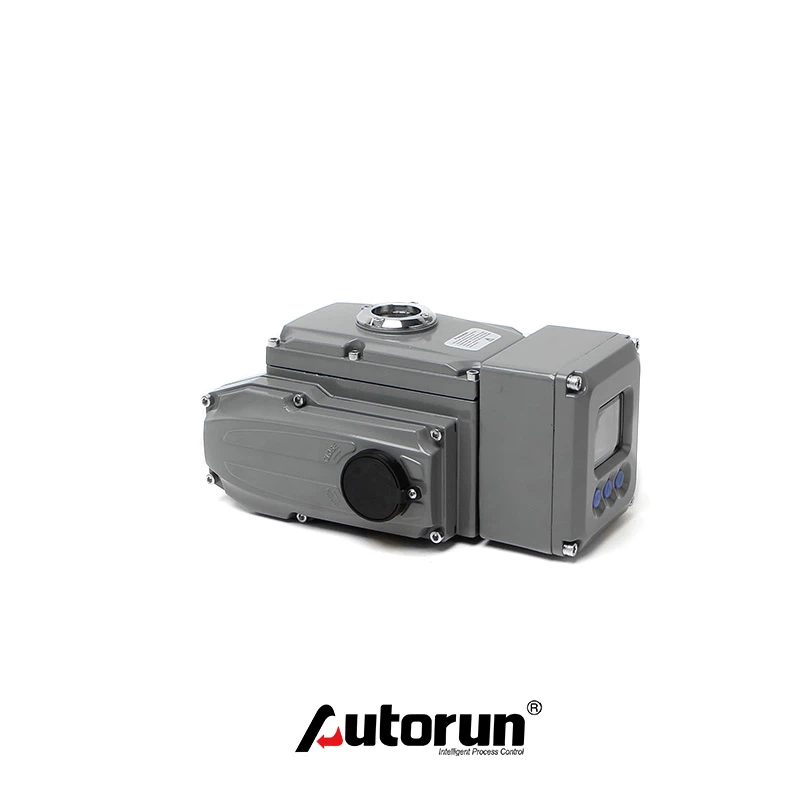


An electric rotary actuator is a mechanical device that uses electrical energy to create rotational motion. The rotational motion can be in either direction. They can be used for turning and placing parts, simple indexing table applications, and as a rotary axis in multi-axis applications. Rotary actuators can move things at any angle required, and can rotate a set amount such as 90, 180, or 360 degrees.


Rotary actuators are designed so that the rotary output motion is a multiple of a 360 degree turn. Rotary actuators are primarily used for control valves where the rotary motion of the actuator is converted via a spindle to the linear motion required for the valve.

: Often a manual rotary actuator will employ a worm drive to increase the torque that a worker can physically apply to close a valve. Such actuators are common on quarter-turn butterfly and ball valves where the self-locking capabilities of many worm drives help to keep the valve shut. These actuators will often use large handwheels to further increase a worker's available torque. These devices are sometimes referred to as "gear operators" or "manual overrides" in the valve industry
An electric rotary actuator typically drives through a worm-gear reducer as well. It uses reversible motors to move the valves between open and closed positions. Models are available that will return the valve to a safe position upon power loss using either stored spring energy or battery or capacitor backup. Generally, the stored spring design requires a more complex transmission to wind the spring. Electric rotary actuators are easily adapted to distributed control systems. Handwheels are also generally provided for manual override, usually with a declutching feature.
Fluid-Powered Rotary Actuators: In fluid-powered rotary actuators such as hydraulic rotary actuators or pneumatic rotary actuators, fluid power from hydraulic oil or air is either applied to cylinders to move rack-and-pinion assemblies and scotch yokes, or to vanned rotors for direct shaft actuation. These actuators generally move between stops of 90 degree to 360 degree , depending on the rotational requirements of a given valve or component.
Rack-and-Pinion Rotary Actuators: Rack-and-pinion styles use at least one, and sometimes two or four, cylinders to drive the rack or racks (a bar with teeth to fit with the gear) past the pinion (which is a circular gear). The pinion rotates in response, driving the output shaft. A rack-and-pinion actuator will continue to revolve the pinion until it reaches the end of the stroke, although modulation is possible both with air and hydraulic systems. Hydraulic systems are better at holding a valve partway open because of the incompressibility of oil. In many instances, the pistons in the cylinders will work against large coil springs which provide the valve with the capacity to return to a safe position during a power interruption.
Scotch-yoke actuators also use cylinders, generally single-acting with spring return. This type of rotary actuator features a sliding bar attached to a valve at one and a yoke on the other, which has a slot for a block that slides back and forth. The sliding block is attached to a piston, so as the piston moves the block pushes the yoke into rotating, which then moves the bar so the valve opens. At the same time, this compresses a spring to that if power were lost, the valve would snap shut. This style is usually limited to 90 degree of rotation and sees applications in quarter-turn valves. Double-acting scotch yoke actuators have no spring, so they need air pressure both to open the valve and to close it.
Hydraulic and pneumatic vane actuators use one or two vanes attached to a hub within a wedge-shaped or circular chamber, where the vane can pivot between 90 degrees to 280 degrees. Air or oil pressure is used to revolve the hub between stops and produce motion at the output stem. Double-vane actuators feature two opposite vanes to provide more torque, although the rotation is more limited than for a single-vane actuator in a full circular chamber. Bladder actuators, in a related design, feature two bladders to either side that push a lever through up to 100 degrees of a circle.
Electric rotary actuators are widely used in robotics, particularly for end-of-arm tooling and material handling.


Q: What is the difference between 12V and 24V actuators?
Linear Electric Cut-off Actuator.
Q: How much can a 12 volt actuator lift?
